
Have you ever poured your heart into a brilliantly written blog post, hit publish, and then heard absolutely nothing but crickets? It is incredibly frustrating. You might have the best writing style in your niche, but if Google can’t figure out what your page is about, nobody is going to find it. If you want to see a real spike in your organic traffic, you need to know exactly which SEO mistakes to avoid.
Let’s talk about what might be going wrong on your pages.
Writing for Bots Instead of Real People
We all want to rank high on search engines. But one of the biggest SEO mistakes to avoid is keyword stuffing. If you force your target phrase into every single sentence, your content becomes unreadable. Google’s algorithms are incredibly smart now. They want to see natural language. Write for your human readers first, and let the keywords flow naturally.
Ignoring the Power of Search Intent
Imagine someone searches for “how to bake a chocolate cake,” but your article is just a history of chocolate. They will bounce off your site in seconds. Not matching the user’s search intent is a massive error. Before you write a single word, Google your topic. Look at what is already ranking. Are they listicles, ultimate guides, or quick tutorials? Give the people what they are actually looking for.
Leaving Meta Tags Blank (Or Making Them Boring)
Your title tag and meta description are your first impression on the search results page. If you leave them blank, Google will just pull random text from your page, which rarely looks good. Failing to write an engaging, click-worthy meta description is right at the top of the list of SEO mistakes to avoid. Think of it as a mini billboard for your website.
By fixing these basic on-page elements, you give your content a fighting chance. Keep an eye out for these SEO mistakes to avoid, and you will slowly but surely see those rankings climb.
Behind the Scenes: Technical & Off-Page SEO Mistakes to Avoid
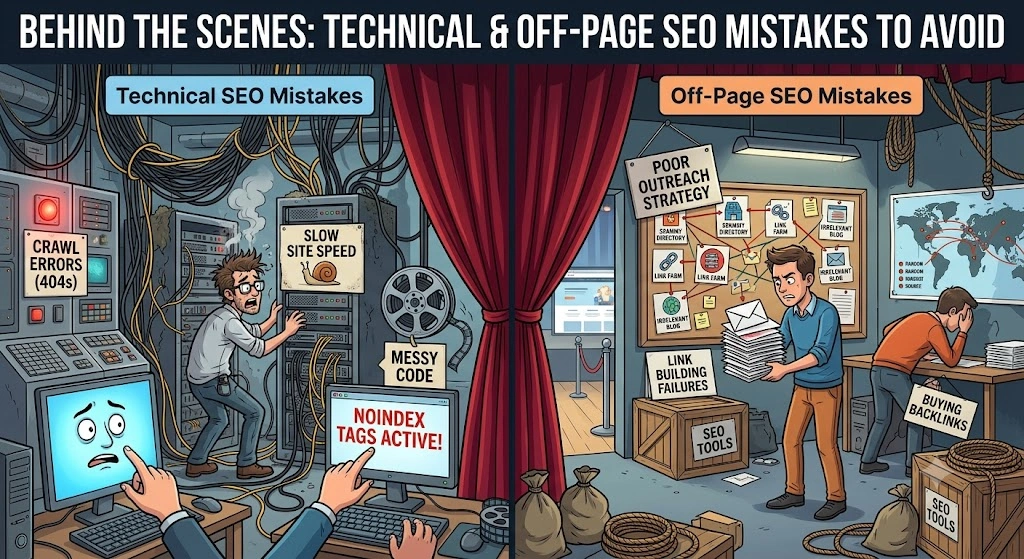
You can have the most beautiful website in the world, filled with amazing articles and stunning images. But if the engine under the hood is completely broken, that car isn’t going anywhere. Technical and off-page optimization can sound intimidating, but getting them wrong will quietly tank your rankings. Let’s break down the technical SEO mistakes to avoid so your site stays in Google’s good graces.
1.Treating Mobile Users as an Afterthought
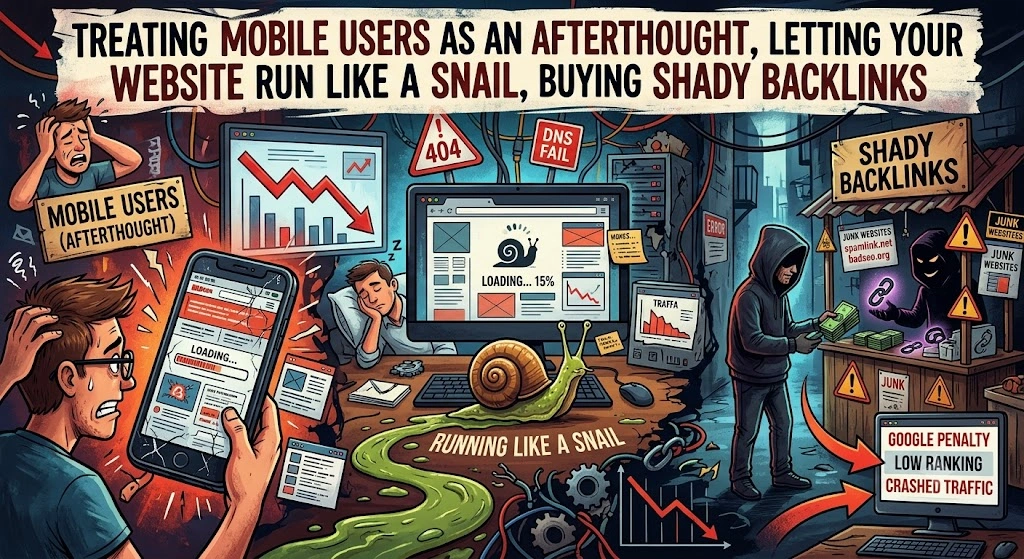
Look around the next time you are on a train or at a cafe. Everyone is staring at their phones. Most of the internet’s traffic now comes from mobile devices. If your website takes forever to load on a smartphone, or if the buttons are too tiny to tap, visitors will leave immediately. Google uses mobile-first indexing, meaning they judge your site based on how it looks on a phone. Ignoring mobile optimization is a major red flag and one of the absolute worst SEO mistakes to avoid.
2. Letting Your Website Run Like a Snail
Patience is basically non-existent on the internet. If your page takes more than three seconds to load, a massive chunk of your audience will just hit the back button. Big, uncompressed images and messy code are usually the culprits here. You can use free tools like Google PageSpeed Insights to figure out what is slowing you down.
3. Buying Shady Backlinks
We all know that backlinks (other sites linking to yours) are like votes of confidence. But trying to game the system by buying hundreds of cheap, spammy links from low-quality sites will get you penalized. Focusing on quantity over quality when link-building is a classic example of SEO mistakes to avoid. You are much better off earning a single link from a highly respected website than paying for fifty useless ones.
Running a website takes a lot of work. But if you take a weekend to run an audit and fix these underlying technical SEO mistakes to avoid, you’ll build a solid foundation for long-term traffic growth.
Frequently Asked Questions (FAQs)
Q: How long does it take to see results after fixing SEO mistakes?
A: SEO is a long-term game. If you fix technical errors (like page speed) or update your content, it generally takes anywhere from 4 to 12 weeks for Google to recrawl your site and adjust your rankings.
Q: Does keyword density still matter today?
A: Not in the way it used to. While you should include your main keyword naturally (around 1% to 2% density is a safe bet), Google cares much more about context, readability, and whether your content actually answers the user’s question.
Q: What is the easiest SEO mistake to fix right now?
A: Missing title tags and meta descriptions. You can log into your website today, rewrite your titles to be more catchy, add a solid description, and potentially see an increase in your click-through rate within just a few days.
Q: Will AI-generated content hurt my SEO?
A: Google’s guidelines state that they reward high-quality content regardless of how it is produced. However, if you use AI to spam the web with low-value, unedited, or robotic-sounding articles, you will likely get penalized. Always add a human touch and real-world experience to your posts.