
Introduction
Staring at a blank screen while trying to craft the perfect pitch is a nightmare every digital marketer knows too well. You know that off-page SEO and high-quality backlinks are the lifeblood of your website’s authority. But when you finally find a high-DR (Domain Rating) website that accepts contributors, your mind goes blank. What on earth should you write about?
Finding unique guest post ideas isn’t just about throwing keywords at a wall and hoping something sticks. It is about understanding the host blog’s audience, filling their content gaps, and positioning yourself as an undeniable authority.
If you are tired of getting your pitches ignored by editors, you are in the right place. In this comprehensive guide, we will break down exactly how to generate winning guest post ideas, how to validate them, and the exact templates you need to secure high-authority backlinks.
What Makes a “Good” Guest Post Idea?
Before we dive into the creative brainstorming process, we need to establish what actually makes a pitch successful. Editors at top-tier publications receive hundreds of emails a day. If your guest post ideas lack these three core elements, they will end up in the trash folder:
- Original Data or Unique Perspective: Has this topic been covered 1,000 times before? If so, what is your unique angle?
- Audience Alignment: Does the topic solve a specific, painful problem for the host blog’s readers?
- Search Volume Potential: Does the post target a secondary or long-tail keyword that the host site currently isn’t ranking for? (Editors love free SEO traffic).
Brainstorming Framework: How to Generate Guest Post Ideas
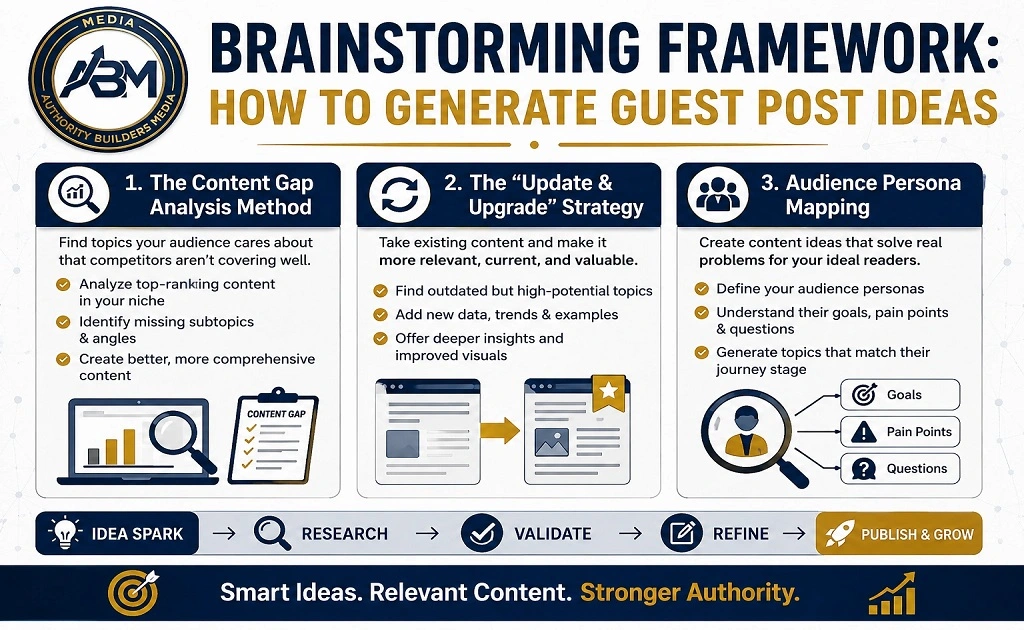
You don’t need to wait for inspiration to strike. Use this systematic approach to generate endless guest post ideas on demand.
1. The Content Gap Analysis Method
This is the holy grail of off-page SEO strategy. Instead of guessing what the host blog wants, look at what their competitors have that they don’t.
- Plug the target blog’s URL into an SEO tool (like Ahrefs or Semrush).
- Find their top three competitors.
- Run a Content Gap analysis.
- Identify high-volume keywords the competitors rank for, but your target blog doesn’t.
- Turn those missing keywords into guest post ideas.
2. The “Update & Upgrade” Strategy
Search for outdated content on the host’s blog. Did they publish a “Top Social Media Trends for 2022”? Pitch them a completely revamped, highly detailed 2026 version.
3. Audience Persona Mapping
If you are pitching to a marketing blog, don’t just pitch “How to do SEO.” Pitch “How B2B SaaS Companies Can Use Technical SEO to Lower Customer Acquisition Costs.” Specificity wins.
Visualizing the Ideation Workflow
Here is a simple flowchart framework to test if your idea is ready for a pitch:
Plaintext
[ Start: Brainstorming ]
       |
       v
[ Does the host blog already have a post on this exact topic? ]
       |-- (Yes) --> [ Can I offer a completely opposite, controversial view? ] --(No)--> [ SCRAP IDEA ]
       |-- (No)
       v
[ Does this topic have search volume or high social share potential? ]
       |-- (No) --> [ SCRAP IDEA ]
       |-- (Yes)
       v
[ Can I provide personal screenshots, case studies, or data? ]
       |-- (No) --> [ Revise angle to include personal expertise ]
       |-- (Yes)
       v
[ PITCH READY: Send to Editor! ]
Top 10 High-Converting Guest Post Ideas (With Examples)
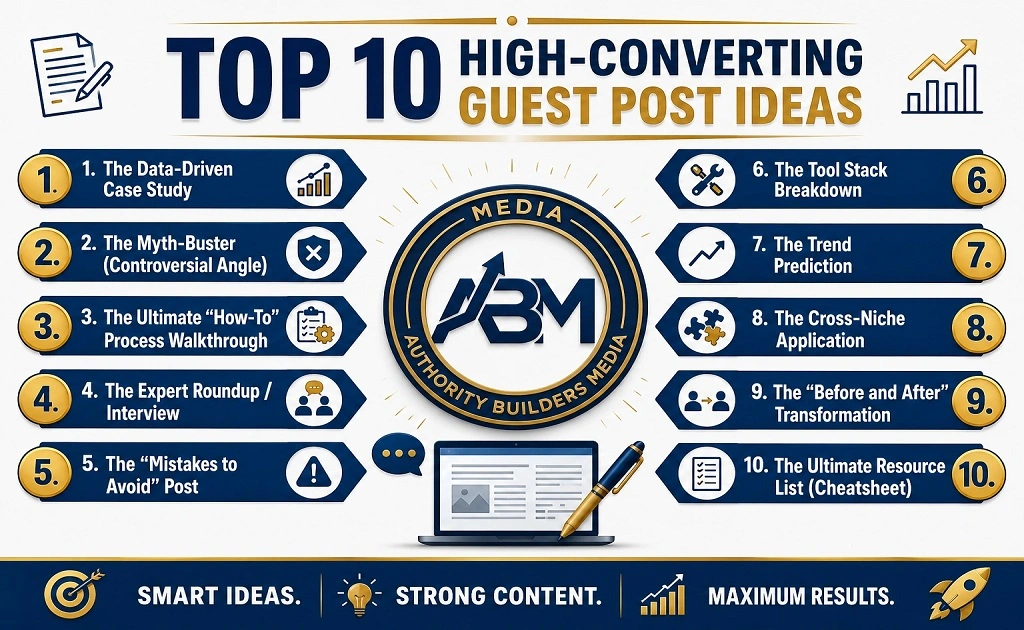
If you need a shortcut, here are ten proven frameworks that editors absolutely love. You can adapt these guest post ideas to fit literally any niche.
1. The Data-Driven Case Study
People love proof. Instead of writing theory, write about exactly what you did, the steps you took, and the results you achieved.
- Example Idea: How We Increased Organic Traffic by 150% Using a Simple Internal Linking Script.
2. The Myth-Buster (Controversial Angle)
Go against the grain. If everyone in the industry is saying “X is the future,” write an article explaining why “X is a massive waste of time.” This generates clicks and debate.
- Example Idea: Why “Content is King” is a Lie (And What Actually Drives Revenue).
3. The Ultimate “How-To” Process Walkthrough
Don’t just give tips; give a blueprint. Break down a complex process into a foolproof, step-by-step guide complete with screenshots and tool recommendations.
- Example Idea: A Step-by-Step Guide to Automating Your Technical SEO Audits.
4. The Expert Roundup / Interview
Reach out to 5-10 micro-influencers in the host blog’s niche. Ask them one specific question, compile their answers, and pitch it.
- Example Idea: 10 E-commerce Founders Reveal Their Biggest Supply Chain Mistakes.
5. The “Mistakes to Avoid” Post
Fear of missing out (FOMO) and fear of failure are powerful psychological triggers. Outline the common pitfalls beginners make in a specific industry.
- Example Idea: 7 Fatal Off-Page SEO Mistakes Ruining Your Domain Authority.
6. The Tool Stack Breakdown
Professionals are always looking to optimize their workflow. Share a highly curated list of tools, but review them based on your actual experience rather than just listing features.
- Example Idea: The Ultimate Tech Stack for Managing Remote Marketing Teams in 2026.
7. The Trend Prediction
Look at current industry shifts and write a well-reasoned post about what the landscape will look like in 12 to 18 months.
- Example Idea: How AI Video Editing Will Change Social Media Marketing Next Year.
8. The Cross-Niche Application
Take a concept from one industry and apply it to another. This results in incredibly fresh guest post ideas that editors rarely see.
- Example Idea: What Healthcare Professionals Can Learn from Retail E-commerce Funnels.
9. The “Before and After” Transformation
Highlight a specific problem a business faced, the strategy used to fix it, and the glorious “after” state. It acts as both educational content and subtle self-promotion.
- Example Idea: Revamping a Legacy Website: A Before and After Core Web Vitals Transformation.
10. The Ultimate Resource List (Cheatsheet)
Curate a massive, well-organized list of resources, templates, or prompts that readers can bookmark and return to again and again.
- Example Idea: 50 ChatGPT Prompts for Advanced Local SEO Research.
Evaluating Your Guest Post Ideas: The Quality Matrix
Use this table to score your guest post ideas before sending an email. Aim for a score of at least 8/10 to ensure a high acceptance rate.
| Evaluation Criteria | Question to Ask Yourself | Points (1-2) |
| Originality | Is this a fresh angle not currently on their site? | |
| SEO Value | Does it target a viable long-tail keyword? | |
| Authority | Do I have personal data or experience to back this up? | |
| Actionability | Can the reader apply this advice immediately? | |
| Audience Fit | Is it exactly aligned with the host’s buyer persona? | |
| Total Score | (A score of 8+ means it’s ready to pitch!) | /10 |
How to Pitch Your Guest Post Ideas (Without Sounding Desperate)
Having great guest post ideas is only 50% of the battle. The other 50% is getting the editor to open your email and say “Yes.”
1. Warm Up the Editor First
Don’t pitch cold if you can avoid it. Follow the editor on LinkedIn or X (formerly Twitter). Leave meaningful comments on their recent articles. When your name pops up in their inbox, it shouldn’t be the first time they are seeing it.
2. Keep the Subject Line Short and Specific
Editors hate clickbait. Be direct.
- Good: Guest Post Pitch: 3 Advanced Off-Page SEO Strategies
- Bad: Amazing Content for Your Blog!!! (Open Now)
3. The Perfect Pitch Template
Keep your email under 150 words. Here is the structure:
- The Hook: Mention a recent post of theirs that you genuinely enjoyed.
- The Value: State that you want to contribute a piece that fills a specific gap for their readers.
- The Options: Provide exactly three guest post ideas (Titles + a 1-sentence summary for each).
- The Proof: Link to 2 pieces of high-quality content you’ve previously written to prove you are a competent writer.
4. Follow Up (Politely)
Editors are busy. If you don’t hear back in 5-7 business days, send a simple one-line follow-up. If they don’t reply to that, move on and take your brilliant guest post ideas to a competitor!
Common Mistakes That Ruin Great Guest Post Ideas
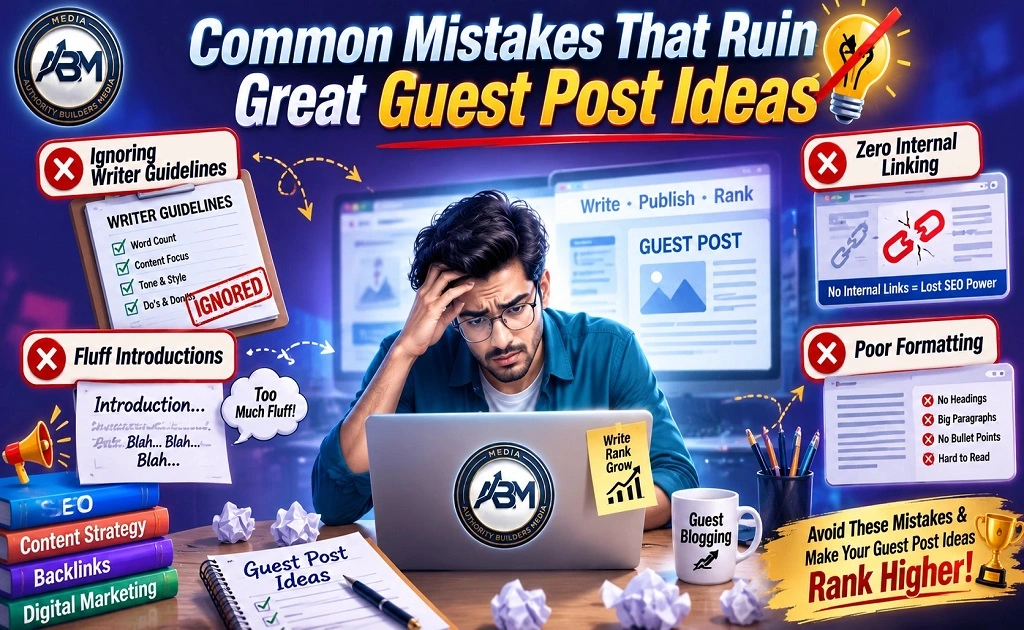
Even the best guest post ideas will fail if you make these rookie formatting and submission mistakes:
- Ignoring Writer Guidelines: If a site explicitly asks for 1,500 words and no promotional links, and you submit 800 words with three links to your homepage, you will be blacklisted. Always read the guidelines.
- Zero Internal Linking: When you write the draft, link to their existing articles. This saves the editor time and shows you actually read their blog.
- Fluff Introductions: Don’t start a post with “In today’s fast-paced digital world…” Get straight to the point.
- Poor Formatting: Use H2s, H3s, bullet points, and bold text. No editor wants to format a massive wall of text.
The “Multimedia Bonus” Strategy: Securing Premium Links with Video Integration
Why Text-Only Pitches Are Becoming Obsolete
As we move deeper into 2026, high-authority blog editors are looking for more than just 1,500 words of text. They are desperate for user engagement, longer page dwell times, and content that they can easily repurpose across their own social media channels.
This is where the “Multimedia Bonus” strategy comes in. If you want to guarantee an immediate “Yes” from an editor, don’t just pitch written guest post ideas—pitch a complete content package. By offering to include a custom, highly engaging short-form video alongside your article, you elevate your pitch from a standard submission to an irresistible digital marketing asset.
How to Offer a “Video + Article” Guest Post Package
When you pitch your topic, mention that you will also provide a custom-branded vertical video (optimized for Instagram Reels or Facebook) that summarizes the core concepts of the article.
Here is why this strategy works like magic for Off-Page SEO:
- Higher Dwell Time: Embedded videos keep readers on the host’s page longer, which is a massive positive signal for Technical SEO and Google rankings.
- Cross-Platform Value: The host blog gets a free video asset to post on their Instagram or Facebook pages, saving their social media team hours of production time.
- Instant Authority: Appearing on camera to explain a complex topic instantly positions you as a high-level industry expert, not just a ghostwriter.
Example Pitch Angle: Technical SEO & Video Integration
Let’s say you are pitching a guest post to a major digital marketing blog. Instead of a generic topic, you use this approach:
The Article Title: The 2026 Guide to Technical SEO: Fixing Core Web Vitals Without a Developer. The Multimedia Bonus: I will also include a custom 60-second video tutorial (formatted for your Instagram/Facebook) where I share my screen and visually demonstrate how to spot these exact Technical SEO errors in Google Search Console.
The Implementation Workflow
To execute this perfectly, follow these three simple steps:
- Write the Core Article: Ensure the written content is heavily detailed, well-structured, and strictly follows the host blog’s formatting guidelines.
- Record the Summary Video: Shoot a high-energy, fast-paced video summarizing the top three points of your article. Keep the editing crisp, add captions, and ensure it aligns with modern digital marketing trends.
- Deliver via Cloud Drive: When you submit your final draft, include a Google Drive link containing the raw video file so the editor can upload it directly to their CMS and social media platforms.
By combining traditional Off-Page SEO outreach with dynamic video content, your guest post ideas will stand out in any crowded inbox, landing you better backlinks on much higher DR websites.
Conclusion
Securing high-quality backlinks through outreach isn’t about spamming 500 blogs with the same generic article. It is about strategic thinking, understanding search intent, and crafting guest post ideas that provide undeniable, standalone value to the host publication.
Start by analyzing content gaps, lean heavily into case studies and personal data, and always offer editors multiple angles in your pitches. The more you focus on helping the host blog succeed, the more they will reward you with the visibility and link juice you deserve.
Now, grab that brainstorming framework, build your pitch list, and start writing!
Table of Contents
Frequently Asked Questions (FAQs) on Guest Post Ideas
1. Why is guest posting so important in SEO and digital marketing? Guest posting is one of the most powerful organic off-page SEO strategies. When you publish well-researched guest posts on high Domain Authority (DA) websites in your industry, you earn quality DoFollow backlinks. These backlinks signal to Google that your site is authoritative and trustworthy, which directly improves your website’s search engine rankings and organic traffic.
2. How do I find high-quality guest posting sites in my niche? Using Google search operators is the best and most effective way to find high-quality sites. You can search Google using your main topic along with these exact match phrases:
Your Keyword + "write for us"(e.g., Technical SEO + “write for us”)Your Keyword + "guest post guidelines"Your Keyword + "submit a guest post"Your Keyword + "contribute to our blog"
3. Do editors accept guest posts written by AI (like ChatGPT)? Direct AI copy-pasted content is almost never accepted by top-tier websites. If you submit unedited AI content, it will easily be caught by AI detectors like ZeroGPT and Duplichecker. It is best to use AI for brainstorming, structuring outlines, and proofreading. To ensure your content is 100% human-written and safe, always inject your personal tone, industry case studies, and real-world examples.
4. What is the ideal length for a guest post article? This entirely depends on the host website’s specific contributor guidelines. However, from an SEO perspective and to provide maximum value, an in-depth, comprehensive article of 1,200 to 2,000+ words usually performs best and gets accepted much faster by editors.
5. How many backlinks should I include in my guest post? A standard and safe approach is to include only 1 or 2 natural links pointing to your own website (typically one in the body content where relevant, and one in the author bio). Additionally, to make the article look natural and valuable, you should internal link to the host blog’s older articles and provide external links to high-authority sites (like Statista, Forbes, or industry journals) for data references.