
Subtitle: Stop guessing and start tracking. Here is the raw truth about organic search, how much it actually costs, and why your local competitors are currently stealing your best customers.
Let’s cut right to the chase. You are staring at your monthly marketing budget, trying to figure out where to put your hard-earned cash. You have Facebook ads running, maybe you bought a billboard, or perhaps you are just relying on word of mouth from previous clients. You know you need more visibility. But then some marketing agency calls you up out of the blue, promising you the moon and the stars, and you find yourself asking the golden question: Is SEO worth it for small business?
It is the smartest question you can ask right now as a founder. Marketing is incredibly expensive. Wasting money on a strategy that doesn’t bring in actual paying customers is a luxury no business owner can afford today. You probably know people who spent thousands of dollars on search engine optimization and got absolutely nothing in return. You also probably know a business owner who gets 90% of their leads directly from Google without spending a single dime on paid advertisements.
So, what is the actual truth behind the curtain?
The reality is that consumer behavior has completely shifted over the last few years. Think about your own daily habits for a second. When your kitchen sink starts leaking at 2 AM, do you grab a phonebook? Of course not. You grab your smartphone and type “emergency plumber near me” into Google. You click on one of the first three results you see, you make a quick phone call, and you hand over your credit card to get the problem solved.
That exact scenario is playing out thousands of times a day in your city, for your specific industry. If you aren’t showing up when people are actively searching for a solution, you simply do not exist to them. Let’s break down exactly why Is SEO worth it for small business, what the real costs look like, and how to make sure you don’t get scammed by shady marketing agencies promising overnight success.
The Brutal Reality of Customer Acquisition Today
Before we look at the solution, we have to deeply analyze the problem. Advertising is getting insanely expensive across the board.
Ten years ago, you could throw a few hundred dollars at Google AdWords or Facebook, and your phone would ring off the hook. Today? The cost per click in competitive industries like law, plumbing, roofing, and real estate is absolutely astronomical. You might pay $50, $80, or even $100 just for a single click. Not a guaranteed sale. Not even a phone call. Just a click on your website.
This financial strain forces founders to re-evaluate their entire long-term strategy. When looking at long-term survival and profit margins, asking Is SEO worth it for small business is really asking whether you want to rent your customers or own your traffic outright.
Paid advertising is exactly like renting an apartment. It’s great for immediate shelter. You pay the landlord, you get a place to stay, and everything is fine. But the absolute second you stop paying rent, you get evicted. Your web traffic drops to zero instantly.
Organic search is like building a house from the ground up. It takes significant time. You have to lay the foundation, frame the walls, and put on the roof. It requires upfront effort and capital. But once the house is built, you own it. You get to live there without paying a massive monthly premium to the tech platforms. Sure, there is general maintenance involved, but the long-term equity belongs to you. Evaluating if is SEO worth it for small business in competitive markets comes down to your willingness to build that equity over time.
The Organic Traffic Ecosystem (Visualized)
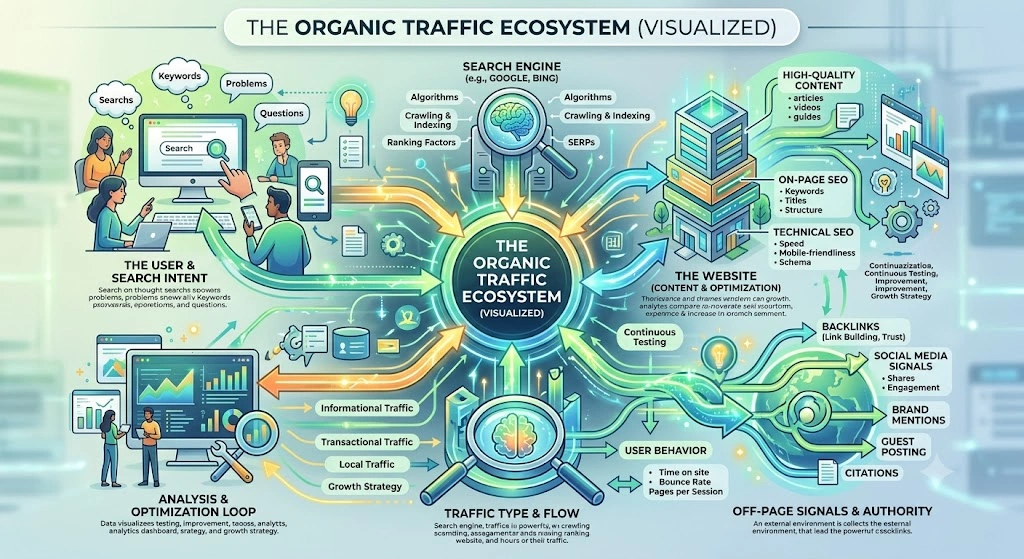
To understand how this all pieces together and see exactly why is SEO worth it for small business, you have to look at the machinery behind a good website. It is not just about writing a few blog posts and hoping for the best. It is a highly interconnected ecosystem that requires technical precision.
Plaintext
====================================================================
                   THE SEARCH VISIBILITY MACHINE
====================================================================

[ PHASE 1: The Technical Foundation ]
   |-- Fast loading speeds (under 3 seconds to prevent bouncing)
   |-- Mobile-perfect design (no pinching or zooming required)
   |-- Clean site architecture so Google bots can read your pages
          |
          V
[ PHASE 2: Relevancy & Content Creation ]
   |-- Targeting exactly what your buyers are searching for online
   |-- Answering their specific questions better than competitors
   |-- Service pages that actually sell the user on your expertise
          |
          V
[ PHASE 3: Authority & Trust Building ]
   |-- Earning links from other respected local businesses
   |-- Getting massive amounts of 5-star Google Reviews constantly
   |-- Being mentioned in digital press, blogs, and news outlets
          |
          V
[ RESULT: The Flywheel Effect ]
   |-- Higher rankings -> More traffic -> More leads -> More sales
   |-- Revenue gets reinvested to dominate the market completely.

====================================================================
If any one of those three core phases is broken, the whole machine falls apart completely. You can have the fastest website on the internet, but if your content is terrible, nobody will buy your services. You can have the greatest written content in the world, but if your site takes ten seconds to load, everyone will leave before reading a single word.
Comparing the Big Three: Where Should Your Money Go?
Business owners usually have three main digital channels to choose from. Let’s look at a head-to-head comparison to really answer the question: Is SEO worth it for small business compared to the other popular alternatives on the market?
| Marketing Channel | Initial Cost Expectation | Time to See Real Returns | Long-Term ROI | The Honest Truth |
|---|---|---|---|---|
| Paid Ads (PPC) | High ($1k – $10k+/mo) | Immediate (24-48 hours) | Low (Costs keep rising) | Incredible for fast cash flow, but horrible for profit margins over a 5-year span. |
| Social Media | Medium (Time intensive) | Weeks to Months | Medium | Great for brand awareness and staying top-of-mind, but intent to buy is usually low. |
| Organic (SEO) | Medium to High | 6 to 12 Months | Extremely High | Requires immense patience. But once you rank, your cost-per-lead drops significantly. |
Looking at that table, the best marketing strategy becomes incredibly obvious. Smart companies don’t pick just one channel. They use paid ads to keep the lights on today, while heavily investing in their organic search presence to secure their total dominance for tomorrow.
The Local Search Advantage: Your Secret Weapon
Here is a massive misconception that holds a lot of people back from starting. A lot of founders think, “How can I possibly compete with massive brands like Amazon, Yelp, or huge national franchises? They have millions of dollars to spend on marketing.”
The good news is that you don’t have to compete with them at all.
Google’s algorithm is incredibly smart. It knows that if someone searches for “roof repair near me,” they don’t want to read a generic Wikipedia article about roofs. They want a guy with a truck in their specific zip code to come fix their house right now.
This brings us to the Google Local Pack. You know exactly what this is—it’s that map that pops up at the very top of the search results showing three local businesses, their star ratings, and a button to call them or get directions instantly. Getting into that map pack is the holy grail for a local storefront or service provider. And here is the absolute best part: national brands cannot physically rank there. Google reserves that spot exclusively for local, verified, physical businesses.
If you are a local shop owner wondering Is SEO worth it for small business, the local map pack is your definitive answer. Optimizing your Google Business Profile, ensuring your name and address are perfectly consistent across the web, and religiously collecting reviews from happy customers will drive more high-quality, ready-to-buy traffic than almost anything else you can do. It levels the playing field entirely.
B2B vs. B2C: Is SEO worth it for small business models of all types?
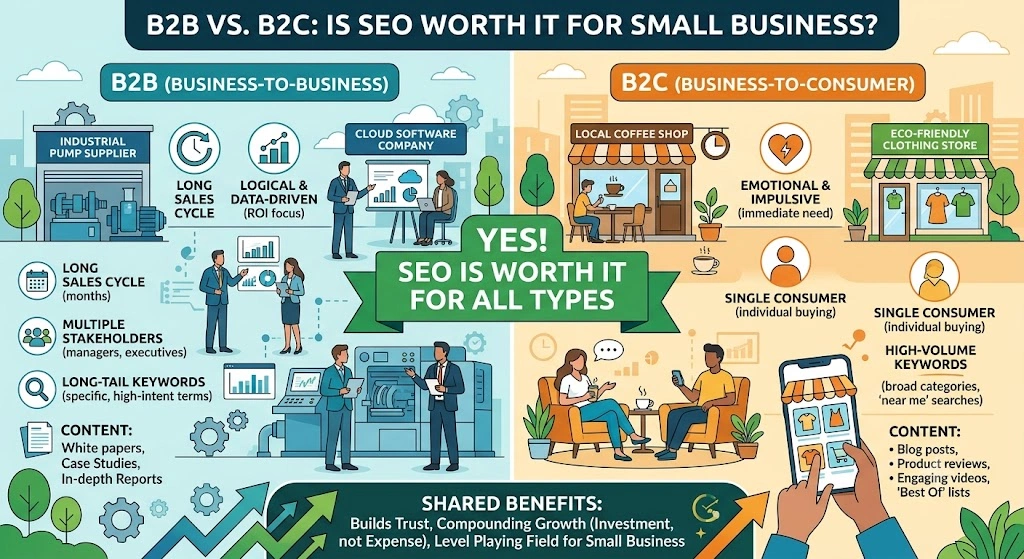
A common question that comes up is whether this strategy only works for retail stores and local home services. What if you sell expensive software, consulting services, or manufacturing equipment to other businesses?
When deciding is SEO worth it for small business operations in the B2B space, the answer is just as strong, but the strategy is fundamentally different. B2B sales cycles are much longer. A company doesn’t buy a $50,000 piece of software on a whim. They research it for months. They search for comparison guides, whitepapers, case studies, and detailed pricing analyses.
If your B2B website provides all of those detailed answers, you intercept the buyer during their research phase. You become the trusted authority before they ever speak to a salesperson. So yes, it works brilliantly across all business models, provided you understand the specific journey your buyer takes before pulling out their wallet.
The Impact of Mobile and Voice Search in 2026
We cannot discuss the future of digital marketing without talking about mobile devices. Over 60% of all internet traffic now comes from a smartphone. If you are wondering is SEO worth it for small business growth, mobile compatibility is non-negotiable at this point.
If a user clicks on your website from their phone and the text is too small to read, or they have to pinch and zoom to find your phone number, they will hit the back button in less than three seconds. Google tracks this behavior. If people constantly bounce away from your site because of a poor mobile experience, your rankings will plummet.
Furthermore, voice search is changing the game. People don’t type the way they speak. They might type “plumber chicago,” but they will ask Siri, “Who is the best plumber near me that is open right now?” Optimizing your content to answer these natural, conversational questions is how you capture traffic from people who use voice assistants to ask a smart speaker, proving that is SEO worth it for small business is no longer just about desktop screens.
Setting Realistic Expectations: The 12-Month Timeline
Let’s talk about why people fail and call the whole industry a scam. The number one reason small businesses claim organic search doesn’t work is simply because they quit too early.
Imagine planting an apple seed in your backyard. You water it for a week, stare at the dirt, and then scream, “This seed is broken!” That is exactly how most people treat digital marketing. They hire an agency, pay them for two months, see no massive spike in sales, and fire them in a fit of frustration.
Search engines move slowly on purpose. They have to crawl billions of pages, evaluate your content, index it securely, and test it against user behavior to ensure you are legitimate. If you want a realistic look at whether Is SEO worth it for small business, you have to look at a 12-month timeline minimum.
- Months 1-3: This is the messy cleanup phase. Fixing broken links, rewriting terrible content, speeding up the website, and doing the heavy technical lifting. You will likely see zero new sales from this phase.
- Months 4-6: You start moving up the ranks slowly. You might jump from page 5 to page 2. Traffic starts to trickle in, but it might not be a massive volume of leads quite yet.
- Months 7-9: You finally hit page one for your target terms. The phone starts ringing. Contact forms start getting filled out. The investment starts paying for itself.
- Months 10-12 and beyond: This is where the compounding magic happens. You dominate your core keywords and start expanding into new, highly profitable niche services.
When you understand this timeline, the answer to the ultimate question: Is SEO worth it for small business when it takes so long? Yes, because the businesses that survive are the ones that plan for next year, not just next week.
How to Calculate Your Actual Return on Investment (ROI)
Don’t let a marketing agency blind you with useless vanity metrics. I cannot stress this warning enough.
An agency will often send a beautiful, colorful PDF report showing that your “impressions” went up by 5,000% and you are now ranking #1 for a specific keyword. But if that keyword is something nobody actually searches for, or it’s a keyword that doesn’t lead to a sale, who actually cares? You cannot take digital “impressions” to the bank to pay your payroll.
To determine if Is SEO worth it for small business, you have to track hard numbers and actual revenue.
Let’s say you run an accounting firm. Your average client stays with you for three years and brings in $3,000 in total profit over that time. That means your Customer Lifetime Value (LTV) is $3,000.
If you pay a true expert $1,500 a month to manage your website and content, that feels like a lot of cash leaving your business. But if their diligent work brings in just two brand new clients a month that you wouldn’t have gotten otherwise, you just generated $6,000 in future profit for a $1,500 investment. That is a massive 4x return. And usually, a good campaign will bring in way more than two clients once it’s fully operational.
You need to track these three core metrics:
- How many organic visitors hit your site every month?
- How many of those visitors actually clicked the contact button or called the phone number?
- How many of those fresh leads turned into paying customers?
Once you have those three numbers, the math does itself, and the answer to is SEO worth it for small business becomes incredibly clear. You stop viewing it as an annoying expense and start treating it as a wealth-building asset.
Beware of the Snake Oil Salesmen
Unfortunately, we have to talk about the dark, ugly side of the marketing industry. The reason so many people doubt if Is SEO worth it for small business is because the digital space is flooded with absolute scammers.
It is very easy to manipulate search engines in the short term using shady, unethical tactics (commonly known as “Black Hat” techniques). Some self-proclaimed “experts” will buy thousands of spammy links from overseas websites and point them directly at your domain. Your rankings will shoot up for about thirty days. You will think they are absolute geniuses.
Then, Google updates its algorithm, catches the spam, and completely penalizes your website. You drop off the face of the earth, your domain is permanently burned, and you have to start all over again with a new web address.
How do you spot a bad agency before you sign a contract?
- They guarantee a #1 ranking. (Nobody can guarantee this except Google itself).
- They refuse to tell you exactly what they are doing month-to-month.
- Their pricing is suspiciously cheap (e.g., $199/month). Good optimization takes dozens of hours of human labor. You cannot buy that for two hundred bucks.
- They don’t ask you any questions about your business, your profit margins, or your ideal customer profile.
Content is Still the Undisputed King of the Internet
You can’t talk about Is SEO worth it for small business without talking about the quality of your content.
In today’s world, lazy people use AI to generate thousands of trash articles in minutes. Google is actively fighting back against this massive wave of spam. They want to show their users real, genuinely helpful, human-created content. They look for E-E-A-T: Experience, Expertise, Authoritativeness, and Trustworthiness.
If you run a local landscaping company, don’t just write a generic, boring article about “how to cut grass.” Anyone can do that. Write an article about “The Best Drought-Resistant Plants for Homes in [Your City].” Include actual, high-resolution photos of jobs you have done in the area. Talk about the specific soil types in your county. Explain the climate challenges unique to your exact location.
Show your undisputed expertise. If you are still wondering is SEO worth it for small business, remember that when you provide insanely valuable information that helps your customer solve a problem, search engines will naturally reward you with traffic. Furthermore, when that traffic lands on your site, they will instantly recognize that you are a true local authority, which makes them far more likely to hire you over the cheaper guy down the street.
Table of Contents
The Hidden Costs: Is SEO worth it for small business owners who bootstrap?
We have talked a lot about hiring agencies, but what if you are bootstrapping your business and have absolutely zero marketing budget? Can you do this yourself?
The definitive truth about why is SEO worth it for small business DIYers is that it is the only marketing channel you can win with purely through sweat equity. You don’t need money to optimize your Google Business Profile. You don’t need money to write a fantastic, 2,000-word guide on how to fix a leaky pipe. You just need time and dedication.
However, time is money. If you are a solo entrepreneur working eighty hours a week just to fulfill your current orders, spending your weekends trying to learn the intricacies of algorithm updates is a fast track to severe burnout. In these cases, answering is SEO worth it for small business depends heavily on your own available time. If you have more time than money, do it yourself. If you have more money than time, outsource it to a vetted professional immediately so you can focus on running your actual business.
Conclusion: Making the Final Call
Building a solid digital footprint is no longer optional; it is a fundamental requirement for survival in a modern, hyper-connected economy. The old days of relying solely on foot traffic, newspaper clippings, and yellow page ads are completely gone forever.
When you strip away the technical jargon, the confusing algorithms, and the flashy marketing reports, you are left with one very simple, undeniable truth. People in your town are actively searching for exactly what you sell, every single day. They have their wallets out, and they are ready to buy.
If your competitors are the ones answering their questions and showing up brightly on their phone screens, your competitors will win their money. It really is that simple. If you have any remaining doubt about whether is SEO worth it for small business, look at your top competitors. They are likely already investing in it.
So, to answer the ultimate question: Is SEO worth it for small business? Yes, absolutely. It is one of the only marketing channels on earth that builds long-term, sustainable equity in your brand, actively lowers your customer acquisition cost over time, and creates a lead-generation machine that works 24 hours a day, 7 days a week, 365 days a year. Be patient, invest your resources wisely, and watch your business transform over the next twelve months.
Frequently Asked Questions (FAQ)
What is the minimum budget I need to get started today?
If you are doing it completely by yourself, the budget can be as shockingly low as $50-$100 a month for basic software tools to track your keywords and check your site speed. However, if you are hiring a legitimate freelancer or agency to do the heavy lifting, you should expect to invest a minimum of $1,000 to $2,500 per month depending on how aggressive your market is. Anything less is usually a massive red flag for poor quality work.
How do I know if Is SEO worth it for small business in my specific niche?
Do a quick, manual search for your main services in your city right now. If you see your competitors running sponsored ads at the top of the page, and you see a map pack filled with local businesses with hundreds of reviews, it means there is serious money to be made. People don’t spend thousands of dollars on ads if nobody is actively searching for the service. If search volume exists, the strategy is highly worth it.
Can I just do this once, get to page one, and then stop paying?
No. Think of it exactly like going to the gym. You can’t work out intensely for six solid months, get in great shape, and then sit on the couch eating junk food for a year expecting to keep your abs. The internet is a living, breathing ecosystem. Your competitors are constantly trying to outrank you and steal your spot. You need a long-term maintenance strategy to protect your rankings once you finally achieve them.
Does social media help my search engine rankings at all?
Not directly, which is why people still ask is SEO worth it for small business when social media exists? Google has formally stated that social media signals (like how many followers, likes, or retweets you have) do not directly impact your search rankings in their algorithm. However, having a strong, engaging social presence builds brand awareness, which leads to people searching for your company by name on Google, which absolutely helps your overall digital footprint and trust metrics.
Is SEO worth it for small business if I only have a one-page website?
It is extremely difficult to rank a standard, one-page website for multiple different services or locations. Search engines vastly prefer comprehensive, deeply structured sites that have dedicated, highly detailed pages for every single service you offer and every specific location you serve. If you only have one single page right now, your very first step should be expanding your website architecture to give search engines more context about exactly what it is you do.