
If you have recently launched a website, you are likely staring at a screen wondering why your traffic is flat. You might have heard the term “SEO” thrown around in digital marketing groups or YouTube tutorials.
But exactly how does SEO work for beginners?
This is the exact question millions of new website owners ask every single year. Search Engine Optimization (SEO) can feel like a secret code. It seems like only a few tech-savvy wizards know how to crack it.
The truth is completely different. SEO is not magic. It is a logical, step-by-step process of proving to search engines that your website is the best answer to a user’s question.
In this comprehensive guide, we will break down every single wall. We will eliminate the confusing jargon. By the end of this read, you will have a crystal-clear understanding of the SEO landscape.
Let us dive deep into the world of search algorithms and discover exactly how you can dominate the search results.
Table of Contents
Chapter 1: The Core Foundation of Search Engines
Before you can optimize a website, you need to understand the referee of the game. In most cases, that referee is Google.
Google has one primary goal: to provide the most relevant, high-quality answer to a user’s search query as fast as possible.
If someone types “best running shoes for flat feet,” Google wants to show them an expert guide on that exact topic. If Google shows them a recipe for banana bread instead, the user will get frustrated and use another search engine.
To prevent this, search engines use three primary functions to organize the internet. Understanding these three steps is the first key to answering the question of how does SEO work for beginners.
- Crawling: Search engines send out a team of digital robots, known as crawlers or spiders. These spiders scour the internet, moving from link to link, discovering new web pages.
- Indexing: Once a spider finds a page, the search engine tries to understand what it is about. It analyzes the text, images, and video files. If the content is valuable, it stores this information in a massive database called the Index.
- Ranking: When you type a query into the search bar, the search engine digs into its Index. It finds the most relevant pages and ranks them from best to worst based on hundreds of different ranking factors.
Your job as a website owner is to make crawling, indexing, and ranking as easy as possible for Google.
Chapter 2: Understanding the Basics: How Does SEO Work for Beginners in Real Life?
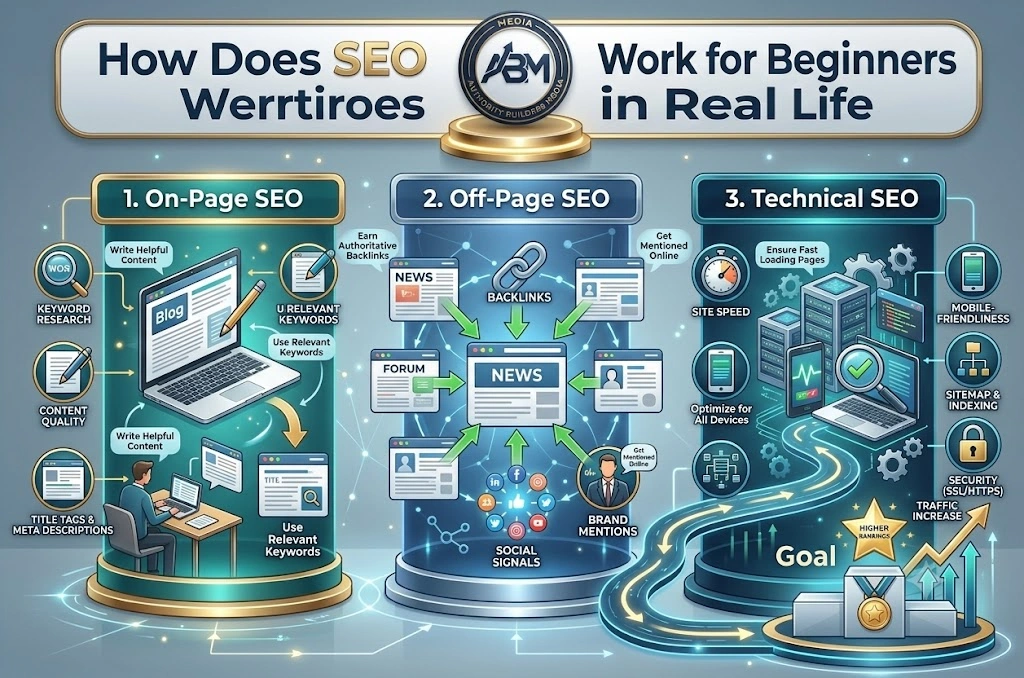
Let us bring this concept into the real world. Imagine you are opening a brand-new coffee shop in the middle of a massive, bustling city.
You brew the most amazing coffee, and your pastries are world-class. However, your shop is hidden in a dark alley with no signs. No one knows you exist.
In the digital world, your website is that coffee shop. The internet is the massive city. SEO is the process of putting up bright neon signs, handing out flyers, and building roads that lead straight to your front door.
When people ask how does SEO work for beginners, they are really asking how to build those digital roads.
To build these roads, SEO is split into three main pillars. If you master these three pillars, you will outrank your competitors effortlessly.
1. On-Page SEO
On-page SEO refers to everything you can control directly on your website. This includes the words you write, the images you use, and how you format your articles. It is all about making your content incredibly relevant to what people are searching for.
2. Off-Page SEO
Off-page SEO involves actions taken outside of your website to impact your rankings. This primarily involves getting other reputable websites to link back to yours. Think of a backlink as a “vote of confidence” in the digital world.
3. Technical SEO
Technical SEO is the behind-the-scenes engine of your website. It ensures that your site loads quickly, works perfectly on mobile phones, and is secure for visitors to use.
Chapter 3: Keyword Research is Your Blueprint

You cannot optimize your website if you do not know what your audience is looking for. This is where keyword research comes into play.
Keyword research is the process of finding the exact words and phrases people type into Google.
For example, if you sell handmade leather wallets, you might think your main keyword is “wallets.” However, trying to rank for a broad term like that is nearly impossible for a new site.
Instead, you need to target long-tail keywords. These are longer, more specific phrases.
Short-Tail vs. Long-Tail Keywords
| Feature | Short-Tail Keywords | Long-Tail Keywords |
| Length | 1-2 words | 3+ words |
| Search Volume | Extremely High | Low to Medium |
| Competition | Very Hard | Much Easier |
| Conversion Rate | Usually Low | Extremely High |
| Example | “Shoes” | “Red running shoes for women size 8” |
If you want to know how does SEO work for beginners, the secret lies in dominating long-tail keywords.
They have less competition, meaning a brand-new website actually has a chance to reach the first page of Google. Furthermore, people searching for long-tail terms are usually ready to take action or make a purchase.
Tools for Keyword Research
You do not need to guess what people are searching for. There are fantastic tools available to help you find golden keyword opportunities.
- Google Autosuggest: Start typing a phrase into Google and see what drops down. These are real searches by real people.
- Answer The Public: A brilliant visual tool that shows you the exact questions people are asking around a specific topic.
- Ubersuggest: A freemium tool by Neil Patel that provides search volume data and keyword difficulty scores.
- Ahrefs Keyword Generator: A powerful tool to find hundreds of related keyword ideas instantly.
Chapter 4: Step-by-Step Guide on How Does SEO Work for Beginners Looking for Traffic
Now that you have your keywords, it is time to put them to work. Creating high-quality content is the absolute most crucial part of SEO today.
Gone are the days when you could just stuff a keyword into a terrible article 50 times and rank on page one. Today, Google’s AI is incredibly smart. It reads content just like a human does.
If you are serious about figuring out how does SEO work for beginners, you must focus on user intent.
User intent is the why behind a search query. Does the user want to buy something? Do they want to learn something? Or are they just looking for a specific website?
The Four Types of Search Intent
- Informational: The user wants to learn. (e.g., “how to tie a tie”)
- Navigational: The user is looking for a specific site. (e.g., “Facebook login”)
- Commercial: The user is researching before buying. (e.g., “best laptops 2026”)
- Transactional: The user is ready to pull out their credit card. (e.g., “buy MacBook Pro online”)
Whenever you write an article, ensure it perfectly matches the intent of the keyword.
If someone is searching for “best budget smartphones,” they want a list comparing different phones. They do not want a 5,000-word essay on the history of the telephone. Give the people exactly what they want, and Google will reward you.
Optimizing Your Content (On-Page SEO)
Once you have written a masterpiece, you need to optimize it for the search engine crawlers. Here is your essential on-page checklist:
- Title Tags: This is the clickable blue link that appears in search results. It must be catchy and include your focus keyword near the beginning.
- Meta Descriptions: This is the short summary beneath the title tag. While it doesn’t directly boost rankings, a compelling description increases your click-through rate (CTR).
- URL Structure: Keep your URLs short, clean, and keyword-rich. Avoid ugly URLs with random numbers and symbols.
- Header Tags (H1, H2, H3): Use these to break up your text. They act as a hierarchy for search engines to understand the structure of your page.
- Image Alt Text: Search engines cannot “see” images. You must describe the image using alt text so Google knows what it is.
Chapter 5: The Power of Off-Page SEO and Backlinks
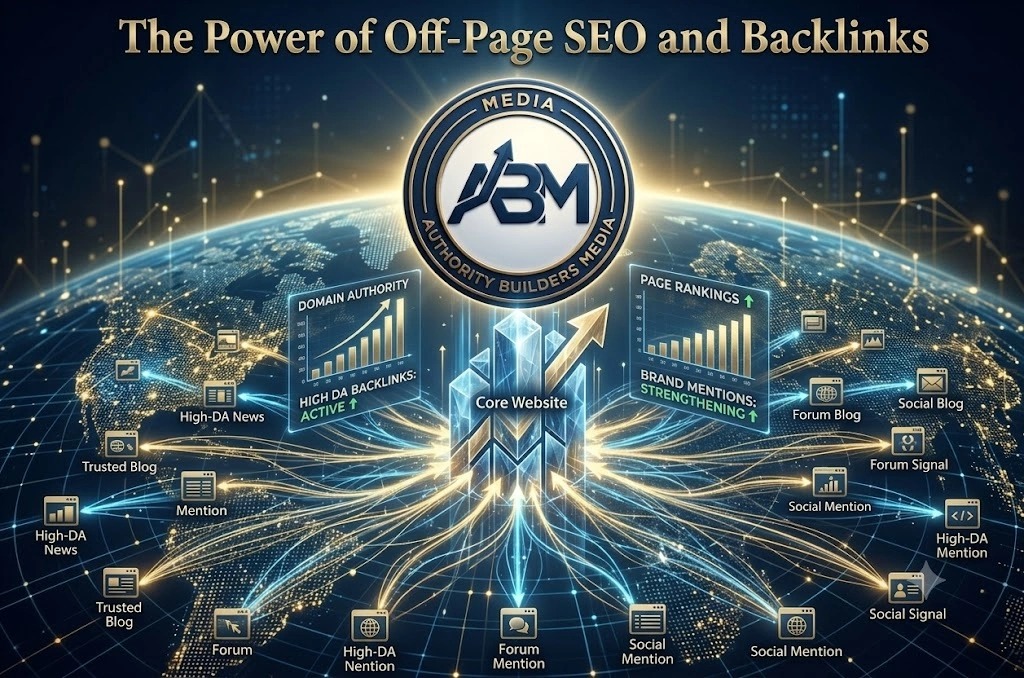
Let us transition to the second pillar of SEO. You can have the most beautiful, perfectly optimized website in the world. But if no one is linking to it, Google might ignore it.
Backlinks are essentially digital referrals.
If Forbes, The New York Times, and a massive industry blog all link to your website, Google takes notice. The search engine assumes, “Wow, if all these important sites are linking to this new site, it must be incredible!”
Therefore, understanding how does SEO work for beginners requires a solid grasp of link building.
How to Get High-Quality Backlinks
Link building is arguably the hardest part of SEO, but it yields the highest rewards. Here are a few proven beginner strategies:
- The Skyscraper Technique: Find a piece of content in your niche that has a lot of backlinks. Write something 10x better, more updated, and more comprehensive. Then, email the people who linked to the old article and suggest they link to your superior guide.
- Guest Posting: Reach out to other blogs in your industry. Offer to write a high-quality article for them for free, in exchange for a link back to your site in the author bio.
- Broken Link Building: Find broken links on other websites (links that lead to 404 error pages). Contact the site owner, inform them of the broken link, and suggest your own relevant page as a replacement.
- Create Shareable Assets: Design beautiful infographics, conduct original industry research, or build free calculators. People naturally want to link to highly useful resources.
Crucial Warning: Never pay for cheap backlinks on sites like Fiverr. Search engines are incredibly smart and will actively penalize your website for trying to manipulate the system with spammy links. Quality always beats quantity.
Chapter 6: The Technical Side: How Does SEO Work for Beginners Behind the Scenes?
Technical SEO can sound incredibly intimidating. The word “technical” often scares away creative writers and small business owners.
However, you do not need to be a coding genius to get this right. Most technical SEO involves basic housekeeping to ensure your site runs smoothly.
If you are exploring how does SEO work for beginners, technical SEO is the engine under the hood of your car. You might have a beautiful paint job (content), but if the engine is broken, the car will not move.
1. Site Speed is Critical
We live in an era of instant gratification. If your website takes more than 3 seconds to load, over half of your visitors will hit the back button. Google tracks this “bounce rate.” If people constantly leave your site quickly, your rankings will tank.
To fix this, compress your massive image files before uploading them. Use a reliable hosting provider. Install a caching plugin if you are using WordPress.
2. Mobile-Friendliness is Mandatory
More than 60% of all internet traffic now comes from mobile devices. Because of this, Google uses “Mobile-First Indexing.”
This means Google looks at the mobile version of your website to determine your rankings, even for desktop searches. If your text is too small to read on a phone, or your buttons are too close together, you will be penalized. Always test your site on your own smartphone.
3. XML Sitemaps
An XML sitemap is literally a roadmap of your website. It lists every single page, post, and category you have.
By submitting this sitemap to Google Search Console, you make it incredibly easy for search engine spiders to find and index your content. Most SEO plugins, like Rank Math, generate this sitemap for you automatically.
4. Secure Your Site (HTTPS)
Look at your browser’s address bar. Does it show a tiny padlock icon next to the URL? If it does, your site has an SSL certificate and is running on HTTPS.
This encrypts the data between your website and your users. Google made HTTPS a confirmed ranking factor years ago. If your site still says “Not Secure,” you are actively hurting your SEO efforts.
Chapter 7: Local SEO vs. Global SEO
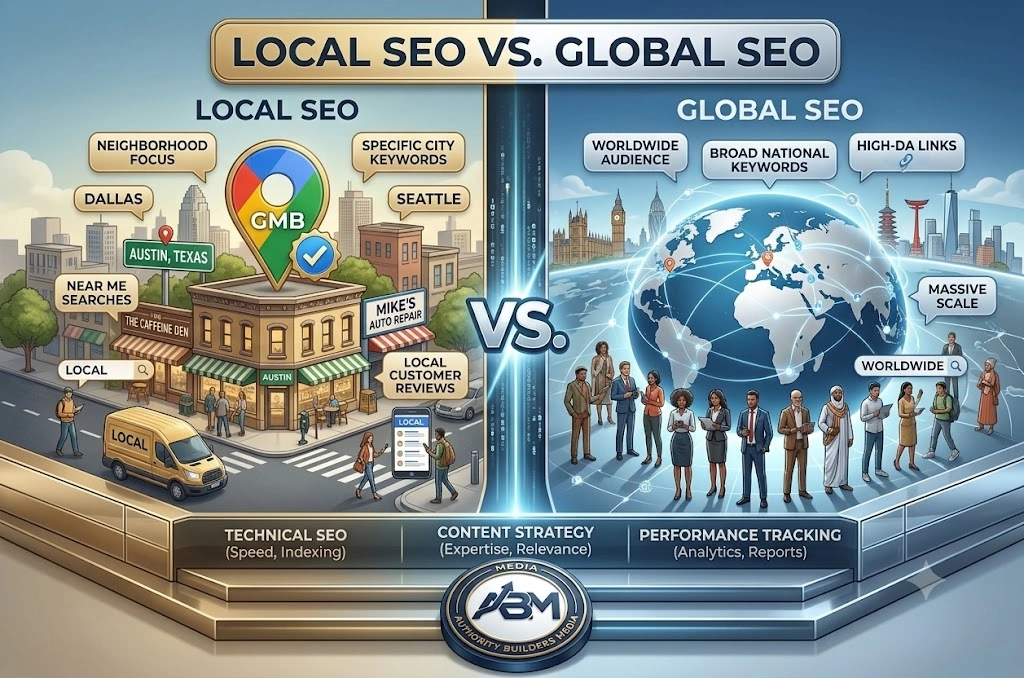
Not every business needs to reach the entire planet. If you run a local plumbing company in Chicago, traffic from someone in London is completely useless to you.
This is where Local SEO comes into the picture.
Local SEO focuses on ranking your business for geographic-specific searches. When someone searches “plumber near me,” Google uses their GPS location to show local results in the “Map Pack.”
Understanding the difference here is vital when learning how does SEO work for beginners.
The Google Business Profile
Your absolute first step in Local SEO is to claim and verify your free Google Business Profile (formerly Google My Business).
This is the listing that appears on Google Maps. Ensure every detail is 100% accurate. Add your exact address, your business hours, your phone number, and a link to your website.
The Importance of N.A.P.
N.A.P. stands for Name, Address, and Phone Number.
Search engines look for this information across the internet on directories like Yelp, Yellow Pages, and local chambers of commerce. Your N.A.P. must be exactly identical everywhere.
If your Google profile says “Main Street” but your Yelp profile says “Main St.”, it can confuse search engines and hurt your local rankings. Consistency is your best friend in Local SEO.
Generating Local Reviews
Customer reviews are a massive ranking factor for local searches. Encourage your happy customers to leave a 5-star review on your Google Business Profile. Always take the time to reply to these reviews, both the positive and the negative ones, to show search engines that your business is active and responsive.
Chapter 8: Measuring Your Success Like a Pro
One of the greatest things about digital marketing is that everything is measurable. You never have to guess if your SEO strategy is working.
However, looking at raw data can be overwhelming. To figure out how does SEO work for beginners, you need to know which metrics actually matter.
There are two primary, free tools provided by Google that every website owner must install immediately.
Google Analytics
Google Analytics shows you how humans interact with your website. It tracks a massive amount of data, but beginners should focus on these key performance indicators (KPIs):
- Organic Traffic: How many people are arriving at your site purely from search engines?
- Average Time on Page: Are people actually reading your 3000-word article, or are they leaving after 10 seconds?
- Bounce Rate: The percentage of visitors who leave after only viewing one page.
- Goal Conversions: Are people filling out your contact form, joining your newsletter, or buying your products?
Google Search Console
While Analytics tracks humans, Google Search Console tracks how the search engine itself interacts with your site. It is arguably the most powerful SEO tool in existence.
Search Console will tell you exactly which keywords you are ranking for. It shows you your average position on Google. It will also send you an email alert if a page on your site breaks or fails a mobile-usability test.
Check this dashboard weekly to monitor the true health of your website in the search results.
Chapter 9: The Most Common SEO Mistakes to Avoid
As you embark on this journey, you will likely make a few errors. That is completely normal. However, there are a few major pitfalls that can severely damage your website’s reputation.
If you are committed to mastering how does SEO work for beginners, you must avoid these deadly sins at all costs.
1. Keyword Stuffing
In the early 2000s, you could write a sentence like: “If you want the best cheap shoes, buy our cheap shoes because our cheap shoes are the best cheap shoes.”
Today, doing this will destroy your rankings. Write naturally for humans first. Use your target keywords strategically, but never force them where they do not belong.
2. Stealing Content (Plagiarism)
Never copy and paste text from another website. Google’s algorithm is incredibly sophisticated at identifying duplicate content.
If it detects that your content is stolen, it will simply ignore your page. In severe cases, your entire website could be de-indexed. Always write 100% original, unique content.
3. Expecting Overnight Results
SEO is a marathon, not a sprint. It takes time for search engines to crawl your site, evaluate your content, and trust your brand.
A brand-new website often sits in a “sandbox” period for the first 3 to 6 months. Do not get discouraged if you do not see massive traffic in week one. Stay consistent, keep publishing great content, and the traffic will eventually compound.
Chapter 10: Frequently Asked Questions About How Does SEO Work for Beginners
To wrap up this ultimate guide, let us address some of the most common burning questions that new webmasters have.
Q1: Can I do SEO on my own, or do I need to hire an agency?
You can absolutely do it on your own! That is exactly how does SEO work for beginners. The fundamentals are free to learn and implement. As your business grows and your site becomes more complex, you might eventually hire a professional, but a beginner can achieve amazing results with sweat equity.
Q2: How long does it take for SEO to start working?
Generally, you should expect to see noticeable movement within 3 to 6 months. However, highly competitive niches (like finance or fitness) can take up to a year or more. SEO is a long-term investment that pays massive dividends over time.
Q3: Is SEO dead with the rise of AI tools?
Absolutely not. While AI tools are changing how content is produced, people still use search engines every single second of the day. As long as people are typing questions into a search bar, SEO will remain a vital marketing channel. The focus is simply shifting towards more human, experience-based content.
Q4: Do social media shares improve my SEO rankings?
Not directly. Google has stated that social signals (likes, retweets) are not a direct ranking factor. However, sharing your content on social media drives traffic to your site and increases the chances of someone linking to it, which does help SEO indirectly.
Conclusion: Your Next Steps to SEO Mastery
We have covered an immense amount of ground today. The world of digital marketing can feel vast, but you now hold the map.
Whenever you find yourself overwhelmed, come back to the core principles. Remember the three main pillars: create amazing on-page content, build strong off-page authority, and ensure a fast, technical foundation.
Stop asking how does SEO work for beginners and start putting these strategies into practice today.
Start by doing some basic keyword research. Write your first highly-optimized blog post. Make sure your title tag is catchy. Share it with your community.
SEO is a skill built through repetition and consistency. The internet is waiting for your voice, your products, and your expertise. Follow the steps in this guide, stay patient, and watch your organic traffic soar to new heights.
Extended FAQ: Everything Else You Need to Know About SEO
Q1: How much money does it cost to start SEO?
The beauty of SEO is that it can cost absolutely nothing but your time. If you are learning how does SEO work for beginners, you can do your own keyword research, write your own content, and optimize your website for free. However, as your site grows, you might choose to invest in premium tools like Ahrefs or hire freelance writers, which can range from $50 to a few thousand dollars a month.
Q2: What is the single most important Google ranking factor right now?
While Google uses hundreds of ranking factors, high-quality, helpful content remains the absolute king. Search engines prioritize content that directly answers the user’s search intent with expertise and authority. If your article provides a better, more comprehensive answer than the top-ranking page, you have a massive advantage, regardless of other minor technical factors.
Q3: Can I use AI tools like ChatGPT to write my SEO content? Yes, but you must be incredibly careful. Google does not penalize AI content just for being made by AI, but it does penalize low-quality, spammy, or inaccurate content. If you use AI, use it as an assistant to outline your ideas or generate titles. Always edit the text heavily, add your own human experiences, and ensure it sounds completely natural before publishing.
Q4: What is the difference between white-hat and black-hat SEO?
White-hat SEO involves ethical strategies that strictly follow Google’s guidelines, such as writing great content and building genuine relationships for backlinks. Black-hat SEO involves trying to trick or manipulate the algorithm using shady tactics like buying thousands of spam links or hiding keywords in invisible text. Black-hat tactics will eventually get your website permanently banned from search results. Always stick to white-hat strategies.
Q5: How many times should I use my exact keyword in an article?
There is no magic number, and focusing too much on exact keyword counts can actually harm your writing. Instead, aim for a natural flow. Include your primary keyword in your main title, one or two subheadings, and naturally throughout the text. Use variations and related terms (LSI keywords) to give search engines a clear picture of what the page is about without sounding repetitive.